Some birds demand attention with bright colours or dramatic size. Others earn it through movement.
The Grey Wagtail (Motacilla cinerea) belongs firmly to the second group. If you've ever walked along a clean stream or river in Ireland, you may have noticed a small bird constantly bobbing its long tail as it darts gracefully from stone to stone. It rarely stays still for long, giving the impression that it's always in a hurry.
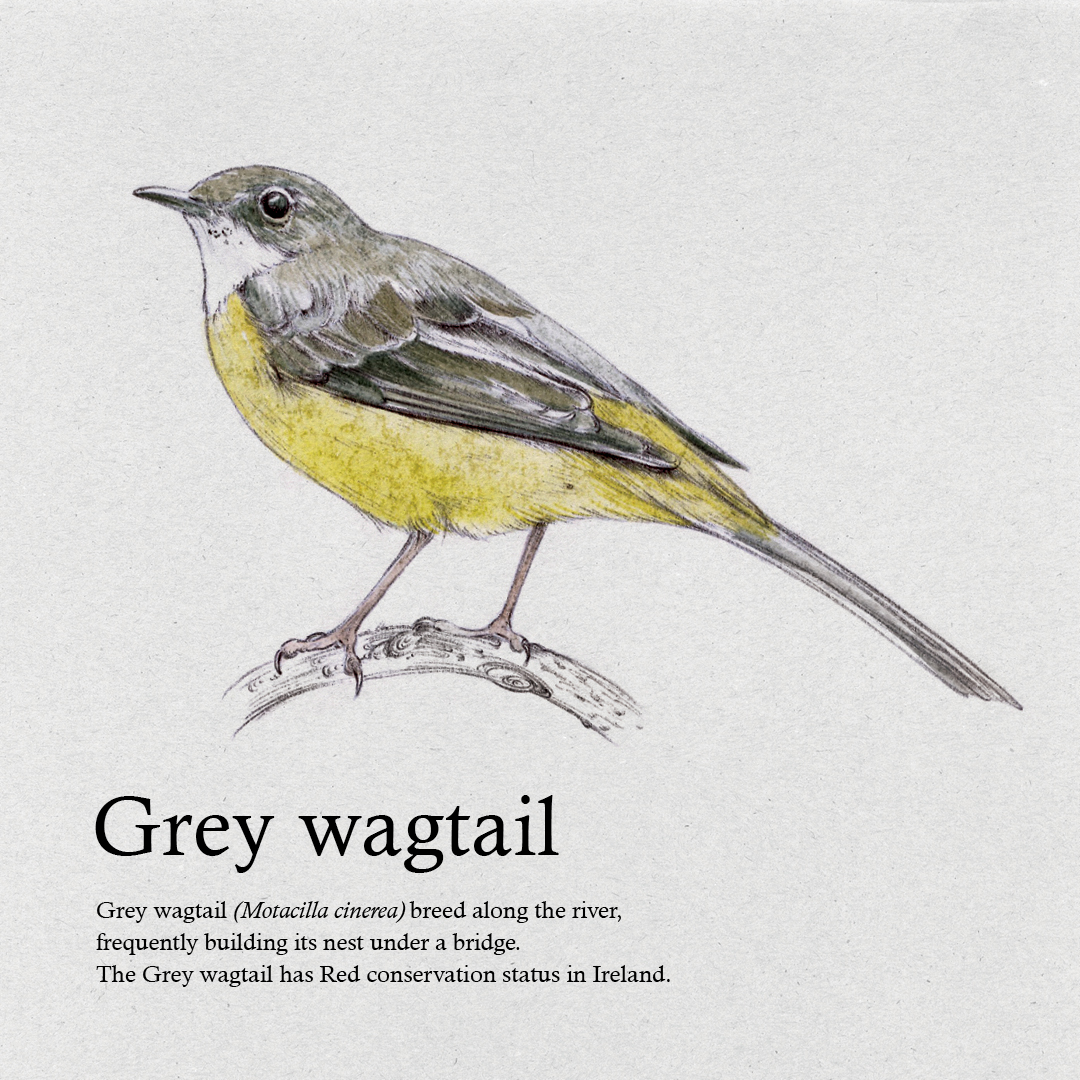
Despite its name, the Grey Wagtail is anything but grey. During the breeding season, its bright yellow belly contrasts beautifully with soft grey upperparts and a distinctive black throat in males. Elegant and energetic, it is one of Ireland's most delightful river birds.
A Perfect Choice for Timahoe
This intricate pen and watercolour drawing was created for a biodiversity and heritage information panel in Timahoe, a picturesque village in County Laois.
Although Timahoe is best known for its remarkable round tower and early Christian heritage, it is equally deserving of recognition for its surrounding natural landscapes. Streams, mature woodlands, hedgerows, wetlands and farmland provide valuable habitats for a wide variety of wildlife, from insects and amphibians to mammals and birds.
The Grey Wagtail was chosen as one of the ambassadors of this rich biodiversity because it depends on exactly the kind of healthy freshwater habitats that still survive around the village. These birds feed mainly on aquatic insects and their larvae, making them an excellent indicator of clean rivers and streams. Where Grey Wagtails thrive, the ecosystem is usually in good health too.
The accompanying text for the biodiversity panel was written by Anne Sundermann, whose work highlights the remarkable wildlife that shares this historic landscape with its people.
Drawing Every Feather
Like many of my wildlife illustrations, this drawing began with careful observation.
I wanted to capture not only the bird's appearance but also its character. The Grey Wagtail has a remarkable lightness about it. It seems to float between rocks, pause for just a second, wag its tail a few times, then disappear downstream before you've had a chance to reach for your camera.
Creating the artwork with pen allowed me to build the delicate feather textures line by line, while subtle watercolour washes brought warmth and movement to the finished piece. It's a slow process, but one that mirrors the patience required when watching wildlife itself.
Perhaps that's what I enjoy most about illustrating birds. The more closely you look, the more fascinating they become.
The Grey Wagtail may not be Ireland's rarest bird or its most colourful, but once you've noticed one dancing along a riverbank, it's surprisingly difficult to forget.